Total Pageviews

Wednesday, October 12, 2011

Guangzhou, China 2011 - Part 4

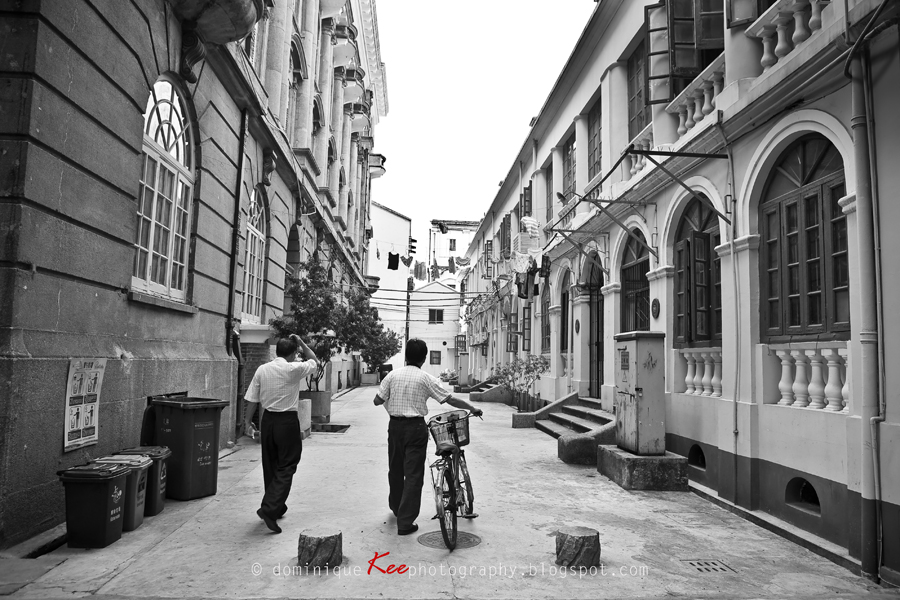
Today we resumed our wanderlust, starting with the scenic Shamian Island. What is Shamian Island? Besides being an island, albeit a very small one accessible by  a couple of bridges, Shamian is a gazetted historical site and contains strong European colonial elements in their buildings. To add, the tranquility, foliage and presence of old people found on Shamian Island gives the impression of a fancy retirement home.

Please click on the images below for a higher resolution picture


One of the highlights of Shamian Island is the French Catholic Church, Our Lady of Lourdes. Descriptively, it is a quaint little chapel with a lone spiral in front centre, and which looks beautifully colonial European.

Please click on the images below for a higher resolution picture


Strewn all over Shamian Island are numerous parks and recreational spots. Apparently retired Chinese nationals have a fondness for exercise and fitness. One good example is a game of Jianzi, which every elderly Chinese plays, quite skillfully too I might add. Jianzi requires participants, who stand in a circle, to keep a weighted shuttlecock in the air, using only their feet. Those old buggers are particularly agile for a bunch of retirees.

Please click on the images below for a higher resolution picture


Interesting fact: Since the early 2000s, Shamian Island has become well known for the many Western couples who reside there while seeking to adopt Chinese babies and young children, most of whom are orphaned and female. However, from 2007, the Chinese government slowed the rate of adoptions, and as a result the percentage of tourists to Shamian Island who are Westerners has decreased as well. Nevertheless, while having lunch at western restaurant on the Island, we did see this firsthand as several foreign families with adopted Chinese children were eating beside us. Why they would want to do that is beyond me. If they wanted a bunch of Chinese kids, I could have given them my siblings.


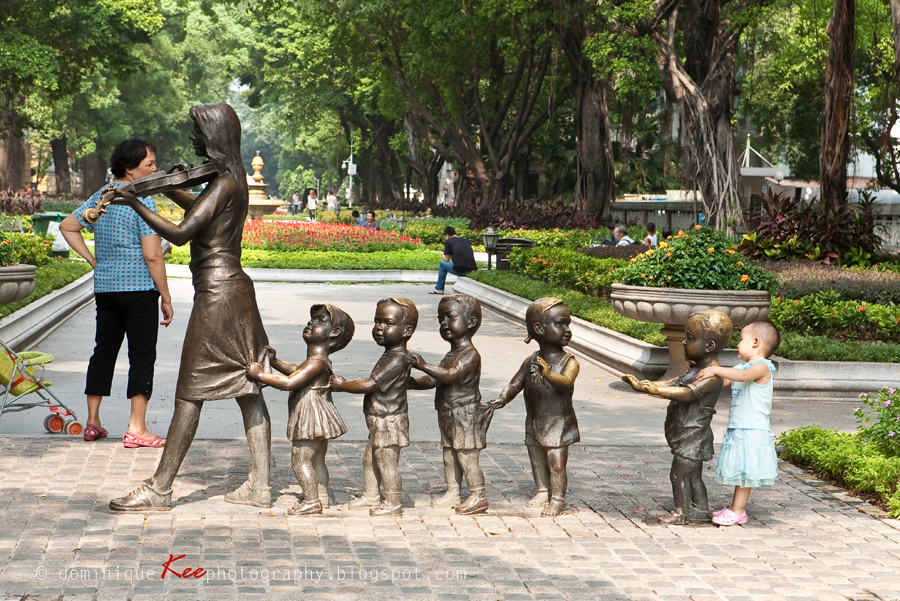
Another interesting tourist point of note: Besides the recreational parks all over Shamian, there are also many, many bronze statues, depicting the everyday lives of the locals, such as kids playing and even photographers lining up for a shot. Here a some of the more interesting ones.


Please click on the images below for a higher resolution picture


After browsing around Shamian Island, we walked across the bridge at the far end of the Island, and headed towards the 'notorious' Qingping Market. There was a time when Qingping Market was known for selling exotic meat, including lizards, insects and dogs even. Today, the Chinese government has actively prohibited such practices and Qingping Market today is rather bland compared to it's notorious.

Qingping Market is not one particular 'market'. In fact, it is an entire area, consisting of many rows of shop , each selling different items. For example, Qingping is famous for the medicinal herbs and plants sold there. Cross the road and you'll find home furniture. Cross another row and you'll find pet stores, and so on.

Please click on the images below for a higher resolution picture


After Qingping Market, we headed straight toward another popular tourist destination in Guangzhou, the Chen Clan Academy and Memorial Hall. This place is like a museum in its own right, with various historical artifacts donated by the affluent Chen Clan in China. Amazing. The Malaysian branch of the Chen Memorial Hall is located in Petaling Street. For the uninitiated, the name of the 'Chen' family members in Malaysia are translated locally as 'Tan'.

Please click on the images below for a higher resolution picture


Thank you for viewing!
For those of you who like statistics:
Vital Stats for October: 2 post 541 pics
Vital Stats So Far: 110 posts 4,454 pics


Disclaimer: The views published in the above photoblog are the author's and the author's alone. If readers are not agreeable with the above views, well, you can bugger-off. All rights are reserved for the photos and the article itself. This article may be reproduced with permission of the author for private or public usage, or other forms of general mayhem. Any unauthorized usage of the images or articles contained therein is expressly prohibited and violators will be prosecuted with the full force of Malaysian law applicable. Thank you for reading this disclaimer.

Wednesday, October 5, 2011

Photography for Dummies, By Dummies: Episode 08

Ever had a question about photography you wanted to ask, but felt it was too stupid? Now you can feel stupid in private instead!

If you've been shooting photos, or have been involved in photography long enough, you can always look back and examine the things you have learned along the way. Once we have enough experience in the palm of our hands, we often reminisce about the past, and we come to realise that some of the things which were told to us, as beginners, were mistaken or even outright wrong! Back then we trusted these sources easily. But today, we are wiser and can see through

This most recent posting in my Photography for Dummies Series is meant to highlight these 'myths'. Don't be surprised that many of us spent (and wasted) a long time believing in some of these 'facts'. With this post, hopefully other beginners are able to learn from our mistakes and develop and learn the correct things.

1.         My photographs aren’t any good

I always hear of photographers getting easily discouraged because they think their photos are not good enough.Well, there is no such thing as instant success. Everything starts from something small. Often, really, really small. We may have taken hundreds of pictures but only a few, if any, turn out well. The road to being a pro at something may not always be smooth, and a bumpy road is to be expected when we are starting to learn a new craft. The trick is to stick with it and keep practicing. With practice, as time goes by, abilities and skills will improve.

To personally share, I've taken photos in the past which I though were brilliant (at the time). Today when I look through the same photos, I feel really embarrassed that I was actually passing those on as 'good' work. Have you ever been in the same shoes? Well, don't be embarrassed! It's all part of the learning process!

2.         My camera isn’t advanced enough

An expensive and advanced camera will not produce good photographs if we do not know how to use it. Take it from me. Take advantage of the cameras at your disposal first, and optimally learn of its capabilities and advance your skills using it. The camera isn’t the major determining factor in producing a good photography; skills trumps fancy camera features.

I started out with the Canon EOS 1000D. I think today, the 1000D has got to be the cheapest DSLR around. Because of the release of the Canon EOS 1100D, the 1000D has been reduced to about RM 1,600.00 complete with the 18-55mm kit lens. Lemme tell you, I took my first money making shots with the 1000D. And that was after thousands upon thousand of photos taken to hone what small skill I have. But can it be done? Yes! In fact, I'm thinking of borrowing a friend's camera for the very purpose of proving the nay sayers wrong.

3.         Certain brands of cameras are more superior than others

Every brand of DSLR cameras available in today’s market have been made to meet the same standards in producing good images. The differentiating factor is the facilities in the certain models, prices and ultimately the personal taste of the users.

Would it make you feel better to believe that your photos are crap because your camera is crappy? Think again. Some of the coolest art shots floating about in cyber-space are Holga/Lomo/etc. shots. Holga's for example, are cheap, russian film cameras which were crappy back then, but have gone in fashion in modern times. The attraction? To take non-stereotype shots (i.e. sharp, in focus, etc.) and make it fashionable.

Photography is an art, and just like art, the artist cannot blame his paint for not being good enough.

4.         A formal education is photography is better than self-learning

I don't really understand this statement. I was entirely self-taught. Except for the handful of times I had a pro or two to show me the light, almost everything I know has been self-taught. And I think I'm doing pretty OK these day.
Though an organized form of education may help in easing the learning of photography concepts, this does not mean that a self-taught photographer is inferior to that of a college graduate photographer. In the end, it’s up to our willingness to learn, whichever way you choose to obtain these knowledge. As they say, where there’s a will, there’s a way.

5.         Good lenses are those with wide apertures

Another great myth! Almost everyone with a little experience in photography equipment instantly wants the widest aperture lens they can find. Don't get me wrong. Having a wide aperture lens is always better than a variable aperture kit lens. Better to have it and don't need it, than need and don't have it. However, not all lenses with wide apertures are good quality lenses. Wide apertures if not balanced with good quality optics will lead to fringing and images will appear soft. The best way to test the quality of a lens is to photography using high contrast settings under extremely bright lights and check to see if the edges of the object is sharp and fringe free.

On a different note, when you actually go out and shoot events, the largest aperture may not always be practical especially for group shots. After all, everyone wants to see themselves sharply. Even for studio portraits, you don't always wants a super-bokeh picture. Have a look around some of the photos online and you can see what I mean.

6.         Professional cameras are full-framed cameras

Most are, but not all. Much of this answer boils down to technical knowledge. Much of Canon's flagship EOS 1D series are in fact 1.3x crop cameras. There are lots of professional cameras with 1.5x/1.6x crop sensors. Full-frames have their own advantages and disadvantages. Full-frame cameras have low noise levels and have a wider photo area, but the speed is usually slower (frames per second). Camera with crop sensors have a higher speed (frames per second) and are more effective for shooting with a telephoto lens.

Bottom line is, stop worrying that your equipment is amateur-ish. Work on your technique and knowledge first.

I can still take good photos with the old 1000D...

If you guys have any thoughts or question on this or any other photography related matter, please do not hesitate to contact me. Thanks for viewing! Until next time

To view other post in the Photography For Dummies Series, please click on the hyperlinks below

Episode 1: You want to buy a DSLR?

Episode 2: Lighting the way

Episode 3: The Rule of the matter

Episode 4: To RAW or not to RAW

Episode 5: How to Shoot Weddings

Episode 6: Image Stabilizers
http://dominiquekeephotography.blogspot.com/2011/08/photography-for-dummies-by-dummies.html

Episode 7: Lighting Technique and Methods
http://dominiquekeephotography.blogspot.com/2011/09/photography-for-dummies-by-dummies.html


For those of you who like statistics:
Vital Stats for October: 1 post 482 pics
Vital Stats So Far: 109 posts 4,395 pics


Disclaimer: The views published in the above photoblog are the author's and the author's alone. If readers are not agreeable with the above views, well, you can bugger-off. All rights are reserved for the photos and the article itself. This article may be reproduced with permission of the author for private or public usage, or other forms of general mayhem. Any unauthorized usage of the images or articles contained therein is expressly prohibited and violators will be prosecuted with the full force of Malaysian law applicable. Thank you for reading this disclaimer.